A Glimpse of Iran

May 23, 2012

Well, it’s been a while since the last time I posted something. The plans to fill this blog regularly remains just as that—plans. But today I’m trying to keep up, updating it with something new. It will be brief, but with pictures :D

An Iranian Women in Yazd’s Bazaar

So now I’m in Iran, traveling to some parts of the country for 13 days (that’s kind of short). Arrived in the middle of last week, my first impression of this country was a little more than I ever expected. Probably that’s because of the everlasting impression created by the Western media—they made us think that Iran is not a safe place to go, and above all it’s on the United States list of the Axis of Evil.

The crumbling part of Yazd’s old city

An afternoon at the Yazd’s old city

The reality is just far away from that. Many times I found out that much of what media said about a country is wrong. And in Iran almost all of it are wrong. I can see how this country which full of kind-hearted Iranians is treated unfair by the world. For me it will be always likely to be on my list of the Axis of Good.

The Amir Chakmakh of Yazd

My travel was begun in Tehran. Unlike most of my travel before, I’m enjoying Iran with a good friend of mine, Mohammad Safir Makki from the Jakarta Globe. But we don’t have a lot of time. Instead of spending more days in the capital, we rushed to Yazd, a city flanked by never-ending desert in Central Iran. Here, where the weather is always burning during summer, we found a warm hospitality of the Iranians even more.

Iranians drive Paykans, the world drives the rest

There are a lot of stories. But I’m prefer to save it for later. This will be just the first.

And today, I’m in Esfahan.

Postcards from Taipei

February 18, 2012

First post this February and I’m not going to write much. After spending one week in Taipei, Taiwan, I realize that I’m a little too tired (especially because of the air travel). So, here are few photos that I took over there. More will be uploaded to my website soon.  Basically, travel and photographing in Taipei were much more enjoyable than I expected. I will cover more details later.

Taipei 101, The World's Tallest Green Building

A View from the Taipei 101

Random Scene from Gongguan Night Market

Valentine's Day Salsa Night

Scene from a Tattoo Studio

Another Random Scene


So That’s it for now :)


Lipka Tatar’s Trail : Garuda Magazine

January 19, 2012

The pictures and words report from my trip to Kruszyniany, a Lipka Tatar village in eastern part of Poland finally published in recent edition of Garuda Magazine (Middle East Edition). It is nicely put on the cover and run six pages inside. What I’m so happy about, my favourite image displayed really well for the double spread title page :)

“These days, along with their muslim tradition, some thousands Lipka Tatars still live in Poland, Lithuania and Belarus.”


Lipka Tatar is a group of Tatar who initially resided in Grand Duchy of Lithuania during the 14th century.  Their ancestors can be tracked back to the Golden Horde, the later Mongolian Khanate famous for its nomadic style of living. But instead of bringing their shamanistic religion from the east, the Lipka Tatars are Sunni Muslims.

The Wodden Mosque of Kruszyniany on the Cover

Tatars, along with their ancestors are famous thourghout history for one thing: horse-riding. In the war-infested medieval times, the Polish-Lithuanian commonwealth saw this as a great chance. This was a right decision. By waging them as soldiers, the commonwealth won some crucial battle, including the Battle of Grunwald against the Teutonic Knight. As the result, the Lipka Tatars gained a noble status which granted them spacious lands to live on.

***

These days, along with their muslim tradition, some thousands Lipka Tatars still live in Poland, Lithuania and Belarus. My visit to Poland on summer 2011 has brought me to Kruszyniany, a small deserted village near Belarus border (there are also another village called Bohoniki). The inital plan was to do an in-depth photo reportage there. But everything wasn’t going too well. I messed up the planning with a bad last-minute research.

Special thanks to (Jedrek Wojnar)

A Note & Postcards from Pacu Jawi

January 15, 2012

A picture is worth a thousand words. Yes, you’ve heard it, and I’ve heard it too. But now a picture is also worth a thousand dollars.

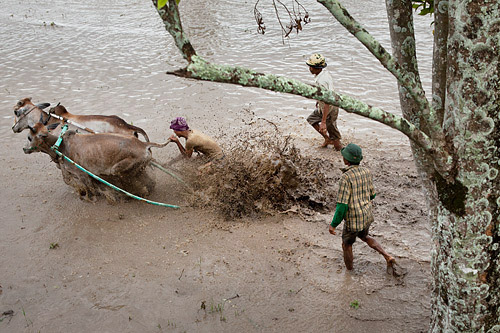
If you’re smart enough, in today’s not-so-nice situation for emerging photographers, you still can sell a photograph for that amount. But here I’m not talking about that. Instead, by saying “a picture is worth a thousand dollars” I’m talking briefly of how a photograph can actually help a community to maintain their tradition. And they are the people of Tanah Datar, who held Pacu Jawi (you can read my description here). The famous Indonesian bull’s racing in West Sumatra.
The Pacu Jawi © Muhammad Fadli

Yesterday, I visited Tabek to shoot Pacu Jawi for the countless times. This village is somehow really special for me since this was the place where I did the Community Development Participation (Kuliah Kerja Nyata or KKN) during my college years in back in 2005. Here, I experienced one of the most happiest moment in my life: shared a real life with villagers for two months. So when a good friend from Tabek called me few days ago telling Pacu Jawi will be held there, I felt like I was facing an offer I can’t refuse (citing The Godfather). Departing from Padang, I accelerated my car passing the winding road that decorate the land of Minangkabau.

“If you’re visiting, you’re guaranteed a tasty local food and the sweet ‘kawa’ without having to be ripped off.”


What I found surprised me. Pacu Jawi today, is being celebrated more than ever before. Three years ago, when I first shot Pacu Jawi, there were only very few outsider watching the raging bulls running through the wet unplanted ricefield. Most people were locals. But then, there were more and more outsiders came, especially after the photographs of Pacu Jawi were published widely (almost all were done by local photographers and you can see my first photo of the festival here). Yesterday there were two Indonesian national TV (with their beautiful hosts), a horde of photographers, and tourists. This is good!!
© Muhammad Fadli
The Pacu Jawi © Muhammad Fadli

The more ousiders come, the more of the local economy will develop (it’s pretty obvious, so I actually don’t need to tell you this). In Pacu Jawi, locals sell anything from foods to toys. If you’re visiting, you’re guaranteed a tasty local food and the sweet kawa (like coffee but different) without having to be ripped off. And I can see that they are started making good business. By looking at this I couldn’t be happier.

So be sure to spend some of your money here.

P.S: If you’re a photographer, the local usually will also ask you to register as a guest. They will ask you for some donation too. Please kindly fill the box as you wish. Don’t mind. This will go directly to the community and making sure the bulls keep running.

(Pacu Jawi is held almost every Saturday somewhere in Tanah Datar. The series in Tabek will be celebrated until early February 2012)

Amok

January 7, 2012

Last night, as me and a friend were driving down a crossroad in Padang,  we saw dozens of men gathered at the roadside.  They shouted out loud indicating a trouble. My Indonesian curiosity led me to park my car at a distance. Before long, I was there among them, sneaked in just to find a man, without his shirt, sprawling and begging for his life on the road. “It’s an amok” I said to my friend. He nodded.

“The times when we have to deal with our own anger, we often show our most honest but barbaric features.”


The word “amok” derived from a remark in Bahasa “amuk”, which literally means a state of fury. But more to an uncontrollable form of it. Psychiatrist would be agree to address this state often occured towards a patient with Schizophrenia. Some people may find it’s quite intriguing of how could an English word (by spelling) absorbed it from Bahasa identically. Most possible that was because they were unable to find a similar context within their society.

Amok © Muhammad Fadli

Looking back at history, there were enough account from the Dutch colony era, where the imperialist got used to see the native Indonesians doing the amok. If somebody got caught of stealing or involved in social distruption, then he is in a great risk, great danger. Even so, the act of amok actually wasn’t only originated in Malay culture. It’s no secret this also happened in many part of the worlds including in Europe.

Back to the man who’s begging for his life, he was accused of stealing a bird. Indeed, a bird. He ran into trouble when he and his friend failed attempt came into light by the resident of (how unlucky he was) an Indonesian Armies residential complex. This is smelled not like a good place to steal. He fell from his motorcycle and got punches galore by a horde of amok’s fans. His friend was lucky enough to escape the crowd.

The times when we have to deal with our own anger, whatever the causes, we often show our most honest but barbaric features. While the unlucky guy laid helpless, some people still manage to kick him hard. I also saw a muscular man stomped him on the face which likely broke his jaw. We did try to stop, but this step often as dilemmatic as we were hushed. There’s always risk of those violent behavior would turn towards us in no time.

A sad, tragic, embarassing, but true post for a weekend.


Follow

Get every new post delivered to your Inbox.

Join 2,427 other followers